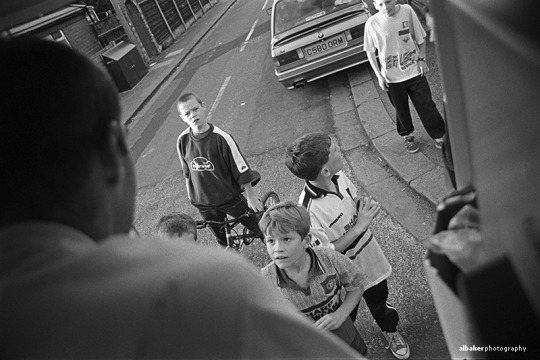
I first came across Al Baker’s photography whilst looking through an old copy of a magazine called Flux I’d snaffled from Manchester’s world-famous second-hand wonderland, Empire Exchange.
Hidden in the magazine’s pages, between an interview with Mark E Smith and a review of a newly-released sci-fi film called The Matrix, were two black-and-white photos, snapped from the window of an ice-cream van, showing kids lined up for a bit of frozen respite from the summer heat. Reading the fairly minimal bit of text below, it turned out the photos were part of a series called ‘Ice Cream You Scream’.
I’d missed the exhibition by approximately 20 years, but thanks to the high-speed time-machine known as the internet, I managed to track him down. Here’s an interview about his fine photos, his time living in Hulme Crescents and the benefits of carrying cameras in a Kwik Save bag…
Classic ‘start of an interview’ question here, but when did you get into photography? Was there something in particular that set you off?
Like a lot of young people, I knew that I was creative but hadn’t quite found my place. I didn’t know whether I wanted to be a writer or in a band. I used to doodle, copy Picasso’s in biro, so off I went to art college and tried my hand at different things. All it really taught me was that I had neither the patience, technique or talent to become a painter. Photography seemed a much easier way to make images, a more instant result. Of course, the more you get into it you realise that whether you’re any good or not does rely upon patience, technique and talent after all.
Was ‘being a photographer’ something that people did in Manchester in the early 90s? Who did you look up to back then?
Not really. It was very rare to see another person wandering around with a camera back then. Even years later when I began photographing the club scene in Manchester no-one else seemed to be doing the same thing. Not at the night clubs I went to anyway.
Now it’s very different. These days you see people with cameras everywhere. Club nights almost always have a photographer. People are far more image-conscious due to social media. Today most people are busy documenting their own nights out with their phones. Look at footage from any major gig these days and half the room is filming it. Back in the 90s no-one seemed to care about documenting anything like that. You were very unlikely to see the photos that someone might be taking the next day or, in fact, ever. People often used to ask ‘What are you taking photos for?’ with genuine surprise or distain.
In terms of photographers whom I looked up to there are so many! There are great image masters like Cartier-Bresson or Elliott Erwitt. Photographers of war and social upheaval like Don McCullin and Phillip Jones-Griffiths. I liked Alexander Rodchenko and Andre Kertez, how they broke the conventions of their day with wit and invention.
I loved the dark and dirty images of Bill Brandt, and his inspiring nude studies too. I loved the city at night recorded by Brassai. Paris in the 1930s definitely seemed to be the place to be. Diane Arbus, Jane Bown and Shirley Baker. American street photographer Gary Winogrand was a huge influence on me, as was Nick Waplington’s book ‘Living Room’.
I was also quite lucky to be living in Manchester at that time. Daniel Meadows and Martin Parr had both attended Manchester Polytechnic. Denis Thorpe had worked for the Guardian in Manchester. I saw Kevin Cummins iconic Joy Division images, Ian Tilton documenting The Stone Roses. Both were regularly in among the inky pages of the NME.
I also saw an exhibition of Clement Cooper’s photographs of the Robin Hood pub in Moss Side, which was another big influence. I was also very lucky in that my very first photography tutor was Mark Warner, who produced very beautiful images, did a lot of work for Factory Records. He shot The Durutti Column’s (1989) Vini Reilly album sleeve. He was probably the first person who ever really encouraged me.
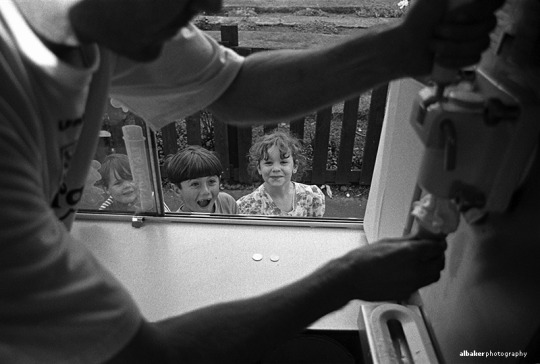
I really like that series of photos you took from inside an ice-cream van in the late 90s. What was the story behind that?
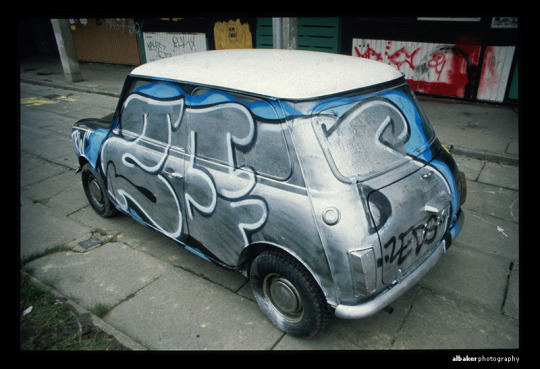
The initial idea for that project came from my friend Steve Hillman, who is an actor. At the time he was ‘between jobs’, which is an actor’s euphemism for being unemployed, so he was working an ice-cream round to help to pay the rent. I was at his flat one night, thinking aloud about where I might go next with my camera. I’d spent quite a long time following graffiti artists work around Hulme, and had my first exhibition based around that. But it only seemed to lead to offers of more work with graffiti artists, and I wanted to do something else.
I’d done a 2nd exhibition based around portraits of my friends in Hulme. I’d flirted with some one-day projects, like Belle Vue dog track, Speakers Corner in Hyde Park. Anyway, while I was talking, not really knowing what I was going to do next, Steve simply stated ‘You should come out on the ice-cream round with me. No-one ever comes to the van without a smile on their face.’ And it just struck me as a beautiful & simple idea. So, one day we just set off. 4 or 5 rolls of film and all the free ice-cream I could eat, which I discovered wasn’t very much!
What was the logistical side of those photos? Were they taken from the same van?
They were all shot on the same day, the same van, all around Salford. It was good fun, but actually very hard work. Trying to constantly find new angles, different framing and working on a hot August day in such a small confined space. By the end of the day I felt that I had enough strong images for my next exhibition. They were much jollier images than ones I’d made before. As a result, because it had more universal appeal, I got quite a lot of good publicity out of it, and Walls gave us hundreds of free Magnum ice-creams to give away on the opening night!
These days I could think of more than a few reasons why you probably shouldn’t drive around Salford photographing other people’s children without permission haha (in fact, I’m surprised that I wasn’t hung from the nearest lamppost!) but I was much younger and far more naive back then. Besides, that was something that I’d learned from living in Hulme. You don’t ask for permission. Someone will only say ‘No’. Just crack on and do it anyway.
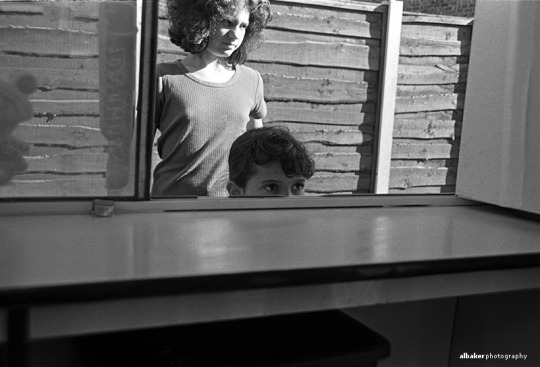
You also documented the last years of the Hulme Crescents. A lot of people talk about that time and place in Manchester, even now—but what was the reality of it? What was a normal weekend there like?
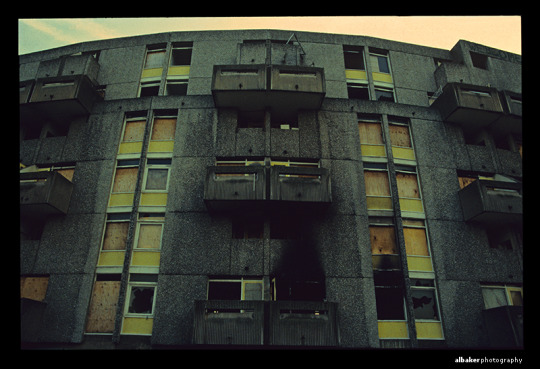
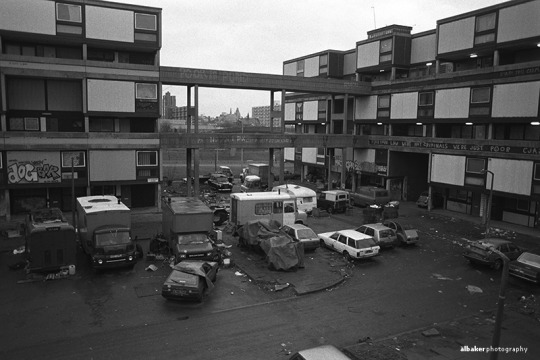
It was quite unlike anywhere that I’d ever lived before. It looked like a fascist dystopian nightmare, only one peopled by Rastas and anarchists. Bleak concrete interconnecting walkways. No through roads whatsoever. A fortress feel to the place. The entire estate was earmarked for demolition before I arrived. Everyone else seemed to be busy moving out. But I was already spending a lot of time there, post-Hacienda, parties, friends, lost weekends.
There were lots of young people living there. Families had mainly moved out as the heating didn’t work properly, flats were cold & damp, often infested with cockroaches. There were traces of old Irish families, the Windrush generation, interwoven with punks and drop-outs.
There was a cultural & artistic flowering among the ruins. A Certain Ratio, Dub Sex, A Guy Called Gerald, Edward Barton, Ian Brown, Dave Haslam, Mick Hucknall, Lemn Sissay, all lived there at one time. It was the original home of Factory, where all the post-punk bands played. In turn that led to Factory Records, New Order, and the Hacienda. The PSV club later hosted raves and notorious Jungle nights. It was a good time to be young.
You lived there as well as shooting it. Do you think it’s important to be a part of the thing you’re photographing, rather than just an outsider with a camera?
I don’t know that it’s important to be a part of the thing you’re photographing, ‘embedded’ is what the war photographers call it, but you definitely capture different images. Certain things that might have been shocking to an outsider were commonplace, normal & every day to me. Boring even. On the other hand, I was much less likely to be robbed walking around. That meant I could take my camera places that other people couldn’t, or maybe shouldn’t!
I used to wear my camera beneath my coat so it couldn’t be seen, and I carried my film and lenses in a Kwik Save shopping bag so as not to attract unwanted attention. I got into the habit of handing that bag over the bar at the pubs I went in. I would collect it the next day if I could remember where I’d been the night before. Bless you, saintly barmaids of old Hulme.
If you look at my images of Hulme people they’re usually reacting to me and not the camera. Either that or they’re not reacting at all. They’re ignoring the fact that I’m taking a picture. That’s what gives them that ‘fly-on-the-wall’ feeling.
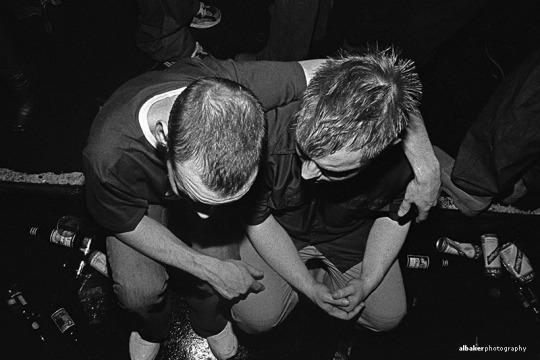
This is something that I put to greater effect later when I was photographing in night clubs, skulking stage side or hiding in a DJ booth. When DJs & MCs see you week in week out at the club doing the same thing they stop posing for the camera and just get used to you being there. You become part of the furniture. And when people stop being conscious of the camera, when they ignore that you’re even present, you can step in much closer. Put simply, you get better pictures. They’re much less performative and far more honest. It’s not often people can say they like it when they’re being ignored, but for photographers it’s a gift.
Do you think somewhere the Crescents could exist now, or was it just a case of the perfect accidental recipe for that kind of creative, DIY activity?
No, I don’t think anywhere like Hulme will ever happen again. I think the city council learned that lesson a long time ago. It was a dystopian utopia for us, but it grew out of failure. When I 1st went to university they warned us never to set foot there. I said, ‘But what if you live there already?’ and there was an embarrassed silence. They really hadn’t expected a poor boy from Hulme to be in the room. Now they own half of it and it’s all student Halls of Residence.
The city centre has been regenerated, redeveloped & gentrified. We can’t afford to live there anymore, and people like me are pushed out. Hulme was a failed social housing experiment, an eyesore & an embarrassment to the people who had commissioned it. People like me moved in & we made it our own. They’re never going to allow anything like that to happen again. Every quaint old fashioned pub that closes becomes a block of flats. The footprint is too valuable to property developers. One day all we will have will be faded photographs to bear witness to a very different way of living.
Was it through the Crescents that you started shooting graffiti?
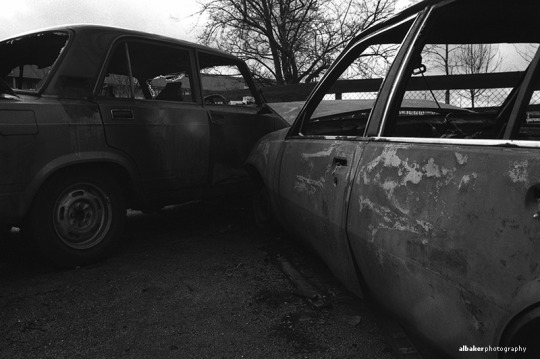
When I first arrived in Hulme I’d just spent 3 years living with mates in a couple of houses elsewhere in the city. It suddenly struck me that that part of my life was over and I had very few photographs of that time. I’d been too busy learning photography, taking the kind of photos that every art student takes: Broken windows; abandoned buildings, and bits of burnt wood. I vowed I wouldn’t do that again. I began documenting the life that was around me.
I started with the architecture, as it was quite unlike any other place I’d ever seen. It had a desperate, faded beauty even then. The whole estate had been condemned for demolition before I arrived, but the city council had given up on the place long before that.
I started to notice graffiti pieces going up, seeing the same names repeated. It was obvious that there was a small group of writers trying out their styles on a large canvas for the 1st time. Wanting to claim this derelict space as their own Hall Of Fame. I started to document them as they sprang up. Then I noted that context was crucial, and so I began to include the soon-to-be-derelict buildings in the images also. The shapes & colours of the graffiti looked positively psychedelic beside the drab monochrome of the setting.
With your graffiti shots, you show a lot more than just the pieces. Was it an intentional thing to show the act behind it a bit?
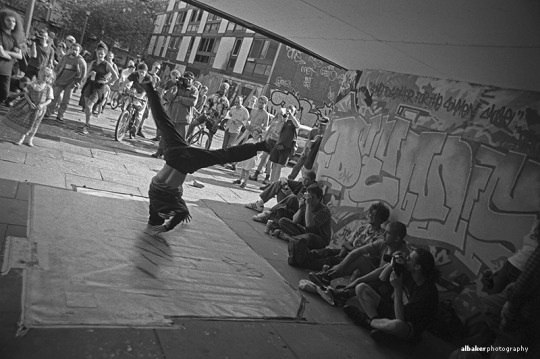
Because it was Hulme and no-one cared, these guys weren’t working in the dead of night like most graffiti writers do in the train yards and what-have-you. They were working during the day, right out in the open. So, documenting their work, it wasn’t long before I ran into Kelzo. He really didn’t trust me at first, but I kept coming back. So, I got to know them. They started to let me know where they were going to be painting next.
In 1995 Kelzo organised the 1st SMEAR JAM event (named after a young aspiring writer who used to come down to Hulme to learn, and had died suddenly from a nut allergy). That was such good fun that another event arrived the following year, another & another. Graf writers came from London, Edinburgh, Leeds, Sheffield, and as far afield as Spain. The local community came out to support and, as usual, it turned into a party that lasted all weekend.
I got into the habit of taking 2 cameras. One loaded with B&W film to capture the event itself, and another with colour transparency to document the finished artwork.
Graffiti… hip-hop… kids getting ice cream… I suppose there’s a few different subjects there, but was there an underlying thing or theme you wanted to show with your photos? Maybe getting a bit philosophical, but they’re all quite free acts—is it about enjoying what’s there?
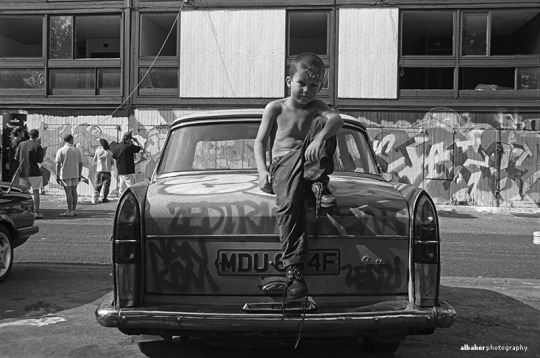
It was more about documenting the life I saw around me. Moving to Hulme was what led to me capturing graffiti, and graffiti led to hip-hop events. Once Hulme was demolished I moved my camera into the city centre and began photographing club nights. House and hip-hop turned into Drum’n’Bass, and then dubstep. Residents and warm-up acts have now become headliners in their own right. Manchester has always been a great city for music, and it kept me busy throughout the naughty Noughties. I’ve pretty much retired from all of that now. I’d had enough after over 15 years of it. I no longer feel compelled to document something as ephemeral as a club night anymore when half of the audience are doing it themselves anyway. Then coronavirus came & properly killed it all off. I don’t know what it’s going to be like now going forward, but it’ll be someone else’s turn to document whatever that is.
What do you think makes a good photograph?
You need to have a good eye. You need to notice & be aware of the world around you. You always see an image before you create one. You don’t require expensive equipment. Mine never was. And you don’t need to be trained. It’s one of those areas where you really can educate yourself. A certain amount of technique and technical understanding goes a long way but, again, you can pick those things up as you go along.
There are different kinds of photography, of course, but for me it was always about capturing a moment. The Decisive Moment, as Cartier-Bresson so eloquently put it. It’s something that the camera has over the canvas. For me the camera has always been a time machine. Like an evocative love song on the radio, it can transport you back immediately to a time & place long gone. It also acts as a witness for those people who were not there. Images tell stories. And we all like to hear and tell stories.
A couple of years ago I was invited to talk at the University of Lancaster for a symposium on documentary photography, which is a tradition that I had always considered my photographs sat within. But oddly, as I gave my slide-show presentation, images that I have seen and shown many times before, and thought I knew very well, I suddenly saw in a brand-new light. I could see myself in every image. Almost like a self-portrait from which I was absent but my own shadow cast large. I realised that I haven’t been documenting anything other than my own life. 25 year old images suddenly had something new to say, something new to tell me.
Do you still take photos today? What kind of things are you into shooting these days?
I don’t really do a lot of photography these days. I teach and facilitate as part of my job now. I still do the odd event but night club photography is a much younger man’s game. I really don’t have the levels of commitment, energy or enthusiasm I once did. I feel like I’ve taken enough images. If I never took another photograph ever again, that’s OK. Maybe, perhaps, I’ll get into a different kind of image making in my twilight years … but for now I’m trying to reassess the images I made 25 years ago. People are far more interested in them now than they ever were at the time. Now they have become documents of a time and place which has gone. The graffiti and the walls that they were written on have disappeared. Many of those night clubs have closed. Time moves on. The images and the memories are all that is left.
Over all those years, how has the art of photography changed for you?
Back when I started taking photographs, where I lived in Hulme, the kind of music that I was into, the magic of a night club moment, there were very few people I knew of who were doing the same thing. Now I am aware of others who were. Almost everyone is their own photographer now. Mobile phones & social media have given a platform for anyone to make & share images of their individual lives, whether it be their friends & families, holidays, public events or more private & intimate moments. Anyone can document their own lives now, so I no longer feel that I have to. I do still love photography, it’s still my favourite form of art, but I don’t feel compelled to capture it all anymore.
I suppose I’ve pestered you with questions for a while now. Have you got any wise words to wind this up with?
If you want to become a photographer you must learn your craft. Keep doing it, and you will get better. But you must remember to always be honest. Make honest images. Listen to the voice of your own integrity. Don’t worry too much if no-one sees any value in what you do. If you’re any good people will eventually see it. It may take years, it did for me, but images of the ordinary & everyday will one day become historical, meaningful & extraordinary.
We live in a world today mediated by images, a Society of the Spectacle, but we still need photographers: People who have a good eye, an innate feel for the decisive moment; what to point the camera at and when to press the shutter. The images that you make today will be the memories of the future.
 Roman Candle Magazine