
Sitting somewhere between occupation and subculture, the role of the bike messenger is one of those rare jobs that extends beyond mere nine-to-five to become a fully-fledged lifestyle.
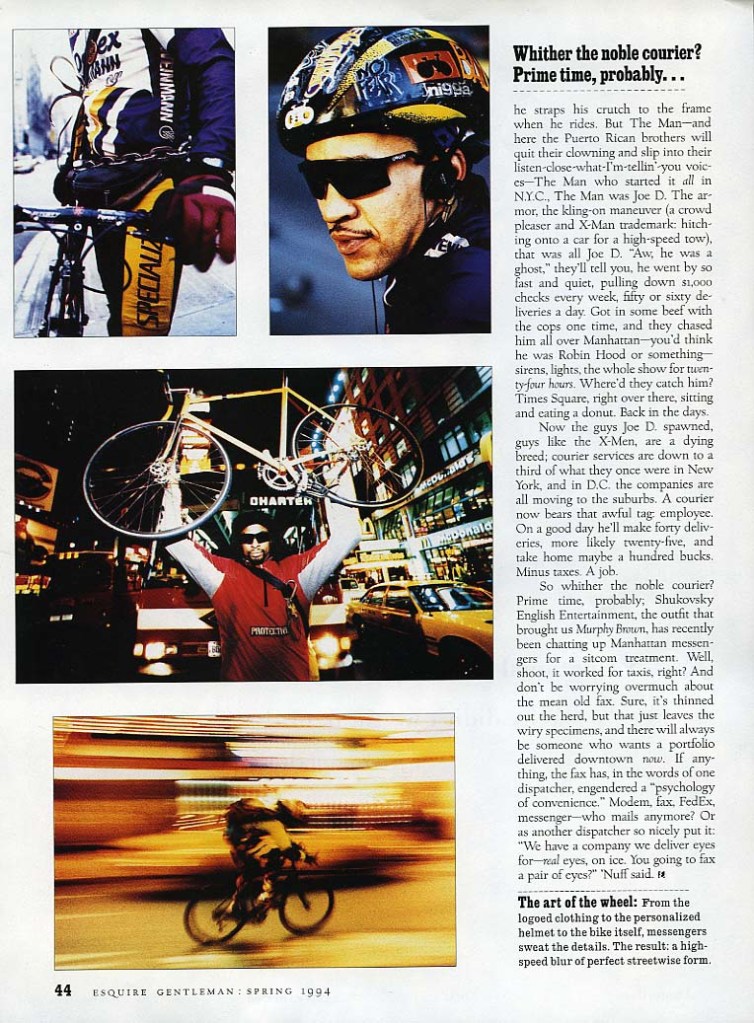
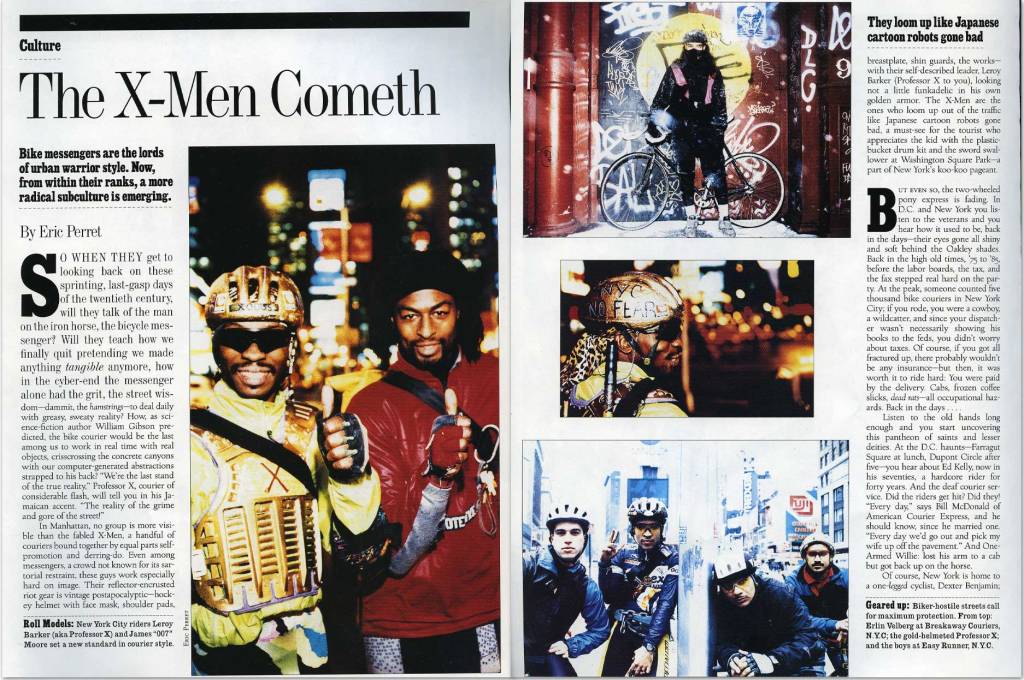
Few did it with quite as much flair as New York’s X-Men. Taking inspiration from a notorious messenger called Joey Love, this crew elevated the fine art of delivering packages into pure street theatre, skitching on taxis, weaving through traffic and leaping over pot-holes, all the while decked out like junk-yard comic-book superheroes.
Anyway—enough intro. Here founding member E-Man lays down his tips for making serious cash on two wheels…
You were just telling me you were in New York again. How was that?
I was there last week on business—I was riding through the city. Everytime I go there I get a bike from one of the bike shops, because everybody knows me out there. I had a great time, remembering my heyday of riding up and down Manhattan. Now I live in South Florida, but I still ride. I do a lot of trail riding now—and I rode all weekend. You ever been to South Florida?
No? What’s that like?
It’s like living on an island, but you’re still in the United States. There’s palm trees and beaches. It’s beautiful.
It sounds it. Going back a bit—can you tell us about the X-Men and what you guys were doing? Even now people talk about you.
There wouldn’t have been 15 film crews coming across the world to film us, if we weren’t doing something unique back then. We changed the landscape of that industry on how packages were delivered. There were many people who wanted to do what we did, and a lot of people who looked up to us and respected what we did.
We were risk takers—I don’t know if we were a group of guys who knew what was going to come out of it, but we just felt that if we wanted to make the most money in a 40 or 50 working week, the only way to do it is by delivering more packages. If the average messenger could deliver 30, then we could deliver 50. And if the average messenger could make $700 a week, then we could make $1200.

How did you make that leap from making $700 to $1200. Was that by skitching? Or going on the freeways?
Absolutely. And there was the clothing—the gear that we wore was so that if anything happened, we could still walk away. If you have motocross gear on, and you’re doing 50 or 60 mph, you’re more likely to get up—you’re going to slide on the concrete and get back up—as opposed to if you’re just wearing regular bike gear.
Like just a t-shirt and shorts?
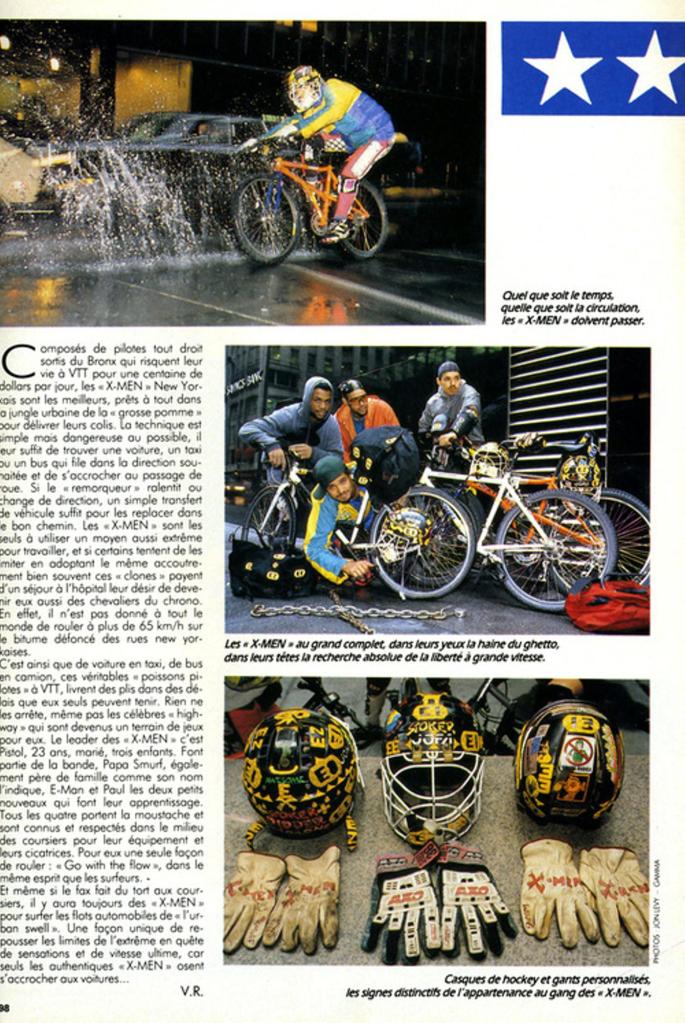
Yeah—some tight biking shorts. And then we wore hockey helmets to protect our faces—and we never rode without heavy duty gloves so that we could hold onto the wheel-wells of the vehicle. And that right there is what separated us from everybody else—we were clinging on to vehicles and swinging from car to car. The lights in Manhattan run simultaneously, so when you go from one street to the next, the lights change from red to green, and as you approach the next street, the lights turn green. It was like catching a street wave—like catching a wave in the ocean when you can get up on the surfboard and ride it though—we called it traffic surfing. So we’d surf through traffic and be able to get from Times Square 42nd Street to Wall Street in less than ten minutes, when it would take the average bike messenger at least 20 minutes or more.
Because they just weren’t taking the risks that you were?
Yeah, and why would they want to? What we did was extremely courageous and dangerous—we put our lives at risk every time we get on the bike.
Did it go wrong sometimes?
Yeah, of course. Obviously if you’re holding onto a car, people who are not nice will try to make you fall. They’ll swerve their car left and right to try and shake you off it. Or if the light is green, it turns yellow, then it turns red, and all of a sudden the pedestrians start crossing whilst you’re doing 45 miles an hour into a bunch of pedestrians, so you’ve got to navigate through that without hitting everybody. It was about beating the red lights, never stopping at a light, navigating all the pedestrians and all the oncoming vehicles that have the right of way.
And then there’s doors opening—people getting out of a cab whilst you’re riding the inside of the street. But that’s really a rookie way to ride through Manhattan. You don’t really ride on the inside lane—you ride in the middle, between all the vehicles, then when you get to your destination you veer off. But since then, they’ve created these bike lanes for all the riders throughout the city—bicycles are one of the main means of transportation throughout the city, so they created these lanes, and they’re pretty nice. But they have a lot of E-bikes out here now.
You rode mountain bikes—was that another conscious decision to get the edge?
We rode mountain bikes—and we rode them with slick tires.
What was yours? A Klein or something?
That bike you’ll see in pictures, that’s a peachy glow in the dark paint job on a Cannondale. It was quite interesting. The T-bar bike instead of the regular road bike with banana bars—they’re much better to control. It was just a much more comfortable bike… and then the front-suspension bike came out. They were more agile, and they could take the roads of New York City a lot better than a bike with thin tires.
Who was the first guy to get onto mountain bikes then for messengers?
We couldn’t take that kind of credit—that’d be me lying over the phone. What we did was that we saw what was out there, and we got innovative. We saw something that could make us stand out—and maybe receive some accolades from our fellow peers on the road, and more importantly, make more money than anybody else. It came with a lot of respect—we were known everywhere.
I suppose I’m calling you up now, over 30 years later, from England.
Yeah, you’re calling me up from Manchester. Back then we were known in the messenger community—in Amsterdam or countries that did messenger work—Chicago and maybe Washington DC. There are still big cities that do courier work. And those communities know who we are. If you mention the X-Men bike messengers, they’re going to be familiar with who we are.
When did you become the X-Men? When did you go from just being a few bike messengers, to being the X-Men?
Some of us worked for the same company. There was a place we hung out at in Midtown, on the east side on 48th street between Madison and Park—we called it the Living Room because there was a heated vent which came off one of the buildings. In the winter time we’d be there warming up and waiting for our next call. We smoked a lot of weed back then, so it was our meeting spot to hang out. At the end of the day we’d meet there then go home together.
The late 80s and early 90s was when we got our notoriety. We all had street names. My name’s Edwin, so I was E-Man, then there was Papa Smurph, the Flash and Pistol Pete. Pistol Pete is still out there—I believe he does Uber Eats.
There was an older X-Man too wasn’t there? Who was that?
Joey the Legend. He was the one who created the style of riding where you hold onto cars. And then we kind of copycatted it, with some more flair. He was a bit more reserved—he wasn’t the kind of person who wanted to be in the spotlight—but he’s on a couple of our documentaries. He was an older guy, and he looked like a jockey—he was tiny, with a small frame and he was the best.
What got you into being a messenger in the first place?
That’s a good question. I graduated from high school and I was a club kid at night in Manhattan. I hung out with this famous DJ in New York—I’d help carry his records—so I had this nightlife thing going on at a young age—but I didn’t know what I wanted to do with myself. Living in Manhattan I always saw these bike messengers ripping up and down the streets, and I said, “You know what, that looks like a job where there’s a lot of freedom.”
It seemed like you could make decent money too—the classifieds were saying you could get $1000 a week. And there were bonuses as well. So what drew me to it was that sense of freedom, and the challenges of getting through traffic on a bicycle, and the money. The money was a motivator.
Being a bike messenger in Manhattan is probably one of the most dangerous jobs you can have. You’re risking your life every time you get on your bike and ride through the city. It was a demanding job. This was pre-internet, and pre-fax machine. If an attorney needed a signature, or a business needed a document delivered from point A to point B, that was the quickest way to get it to someone. We’d deliver a lot of blueprints from architects—we delivered anything.
One time I went to Andy Warhol’s studio and picked up a painting and delivered it to Madonna. It was a pretty interesting job. We’d all meet at Washington Square Park after work—we’d hang out, talk about our day—drinking beer and smoking weed. We were rebels.

I suppose it’s one of those occupations that’s more than a job. It’s a subculture.
Absolutely. That was the thing that attracted me to it. It was a 1099 which is considered contractor work—I was my own boss.
Which is pretty cool for an 18 year old.
Right! I wasn’t working for corporate America. That was pretty cool, and I really enjoyed that part of the job. We knew that we weren’t like everybody else. The nine-to-five people walking through the city. They were all corporate. They were all suits walking through midtown Manhattan. You’re essentially delivering to corporate America.
How did they look at you?
I don’t really know. I didn’t really care. I wasn’t worried about what people thought of me. What worried me the most was making sure that I got home every night in one piece. It was a job that required a high level of skill on a bicycle—you had to know how to read the grid—how to read traffic and the streets—and many people have died as bike messengers in the city.
What else was going on around at this time? What’s life like for you back then?
Back then because my friend was a famous DJ I was in clubs like Danceteria, the Limelight, the Tunnel, Studio 54, Palladium—these were the clubs back then. As a messenger you created your own time. You could be at work at 7:30am, or you could stroll in at 1 in the afternoon and work until 8 at night. You stood out as long as you wanted to, or left as early as you wanted to. And the more notoriety and reputation we gained in the messenger world, the easier it was for us to do whatever we wanted to do. Companies wanted to have someone like us on their roster—if you’ve got an X-Man or two, you’ve got one of the best in the business.
We took our job pretty seriously, and although we may have done things like drink beer or smoke weed throughout the course of the day—when the beeper went off, that was it. The beeper would display the office number, so you’d shoot over to a telephone booth—back then they were on practically every corner—and you’d call into the office. The dispatcher would dispatch you anything from one to five runs in one shot. They’d geographically give you the runs so you’d pick them all up in the right order, all relatively close to each other and all in the same direction.
You could get a rush, a double rush or a triple rush. The more the ‘rush’ the package was, the more it cost to deliver it. So a triple rush was going to cost you $70. That’s a lot of money to deliver a package from point A to point B—and you’d get 60% of that, you got the lion’s share.
But you’ve got to do that faster?
Yeah—triple rush was less than 10 minutes. Double rush was less than 15 and a rush was less than 20. And then for a regular package you got it there within the hour. If you can make 150 or 200 dollars a day, all you need is two triple rushes and you’ve got 90 dollars right there—along with whatever else you make through the day—so you could make 150 to 200 dollars a day if you averaged things out. Back then that was good money. If you made 1000 dollars a week back then, you were considered a great messenger.
When did you stop? Was there a point when the X-Men faded away?
I lived in Manhattan—in a very affluent neighborhood on the Upper East Side—but the other guys lived in the Bronx. I had a whole different lifestyle than they did. My whole thing was a lot different to my friends—I was a club kid at night, so that came with a lot of different things. So I did it for maybe five or six years—and by the age of 24 I was done. I moved on. I knew that I didn’t want to be a messenger for the rest of my life.
That particular moment in my life was about being great at what I was doing, and getting the most out of it. There were about 14 documentaries on us, along with interviews on the radio and articles in newspapers and magazines. We were on the front cover of the Sunday edition of the New York Times magazine. MTV interviewed us too, but they decided to go in a different direction because they didn’t want the liability of someone holding onto a vehicle after seeing it on their show—but that was no big deal. We had film companies from all over the world document our story.
And although you’re not a messenger, you’re still riding now.
I found the love for riding as a bike messenger—I always loved that feeling of pushing my body to ride as fast and as hard as I can. Cycling is a way to stay young. I’ve never seen a person overweight on a bicycle! I love food, and I’ve been overweight before—but the only thing that helped me lose weight was riding. At one point I was obese, but I got down to where I am now because I got back on the bicycle. I love riding because it keeps you young—and that’s important to me.

Definitely. Okay, rounding this off now, money and fame aside, what is your fondest memory from your time as a bike messenger?
My fondest time as a messenger was meeting the people that became my life long friends. So many memories and great times as a messenger but one that stands out would be jumping on the west side highway while a film crew was filming a documentary on us and jumping from the express lane to the local lane over a cement divider at 60 miles per hour.
Like I mentioned, the friendships and brotherhood of the bike community by far the best thing that came from that experience. Being able to accomplish something that till today has never been duplicated is a great feat in itself. Leaving a legacy in the bike community around the world is something to be proud of. The bike community has shown us much love throughout all the years. 30 plus years later and we are still talked about around the world. X-Men for life!
 Roman Candle Magazine